7 Best Bodyweight Exercises for Weight Loss at Home (No Equipment)
Two years ago, I stood in my living room, staring at a dusty gym membership card I hadn’t used in six months. I was tired of the commute, the waiting for squat racks, the awkward eye contact while someone else used ‘my’ cable machine. So I decided to try something different: a bodyweight workout, right there on my rug, wearing an old t-shirt and shorts. No dumbbells, no bands, no excuses. That first session was humbling—I could barely do ten push-ups and my legs shook during lunges. But within three weeks, I noticed changes: my jeans fit better, I had more energy in the afternoons, and I actually looked forward to my 25-minute sweat sessions. The best part? I didn’t spend a dime.
If you’re skeptical about whether bodyweight exercises can really help you lose weight at home with no equipment, I get it. The fitness industry sells us the idea that we need shiny gear and gym memberships to see results. But the truth is, your own body is one of the most effective resistance tools you own—and when used correctly, it can torch calories, build lean muscle, and boost your metabolism just as well as any machine. In this article, I’m sharing the seven best bodyweight exercises for weight loss at home (no equipment required), based on what actually worked for me and what the science supports. You’ll also get a sample routine, common pitfalls to avoid, and answers to the questions I hear most often from friends who’ve tried this approach.
Why Bodyweight Workouts Beat Gym Machines for Weight Loss
Here’s the counter-intuitive truth: machines are actually less efficient for weight loss than bodyweight moves. Here’s why.
1. Compound movements recruit more muscle groups. When you do a squat, you’re using your quads, hamstrings, glutes, core, and even your back for stability. A leg extension machine isolates one muscle at a time. More muscles working = more calories burned per minute, and a greater afterburn effect (excess post-exercise oxygen consumption, or EPOC). A 2020 study from the American Council on Exercise found that bodyweight circuits involving multi-joint moves can elevate metabolism for up to 24 hours after training—meaning you keep burning calories while you binge-watch your show.
2. No equipment means no barriers. The biggest enemy of weight loss consistency is friction. If your workout requires a gym, you’ll find reasons to skip it—bad weather, traffic, feeling tired. Bodyweight workouts let you train in your pajamas, and that convenience has a massive impact on adherence. In my own experience, I went from missing 3–4 gym sessions a month to missing zero home workouts over a six-week period. The math on that is simple: more sessions equals more calorie deficit equals faster results.
3. Bodyweight exercises improve mobility and balance. Machines lock you into a fixed plane of motion, which can actually decrease functional strength and increase injury risk over time. Bodyweight squats, lunges, and push-ups train your body to stabilize itself, which translates to better performance in sports, daily activities, and even other workouts.
That said, there’s a catch: you can’t just do a dozen half-hearted squats and expect your jeans to fall off. Bodyweight training for weight loss requires intention—proper form, progressive overload, and enough intensity to make you sweat. That’s exactly what the next section delivers.
The 7 Best Bodyweight Exercises for Weight Loss at Home (No Equipment)
These are the moves I rely on most. Each one is ranked by its fat-burning potential based on muscle recruitment, calorie burn per minute, and how easy it is to progress. I’ve included form cues, why it works, and how to make it harder or easier.
1. Squat (Standard and Jump Variations)
Why it torches fat: Squats engage the largest muscle groups in your body—glutes, quads, hamstrings, and core. A 155-pound person can burn roughly 10–12 calories per minute doing bodyweight squats at a brisk pace, according to Harvard Health data. When you add a jump, you spike your heart rate into the HIIT zone, which amplifies calorie burn during and after the workout.
How to do it right: Stand with feet hip-width apart, toes slightly turned out. Keep your chest up and back straight. Push your hips back as if sitting in a chair, lowering until your thighs are parallel to the floor (or as low as your mobility allows). Drive through your heels to stand up. For the jump variation, explode upward, reaching your arms overhead, and land softly with bent knees.
Progress it: Too easy? Add a pulse at the bottom (three small pulses before standing). Too hard? Do a box squat onto a sturdy chair or couch, then stand up. Aim for 3 sets of 15–20 reps.
2. Push-Up
Why it torches fat: Push-ups hit your chest, shoulders, triceps, and core. They also require full-body tension, which burns more calories than isolated arm work. When I started, I couldn’t do a single full push-up, so I did incline push-ups on a coffee table for two weeks. By week three, I was doing 12 full reps and my arms actually looked different.
How to do it right: Start in a high plank with hands slightly wider than shoulder-width, body forming a straight line from head to heels. Lower your chest to the ground while keeping elbows at a 45-degree angle to your body. Push back up explosively. Keep your core braced the entire time—don’t let your hips sag.
Progress it: Easier: knee push-ups or incline push-ups on a counter. Harder: decline push-ups (feet on a couch), diamond push-ups, or clap push-ups. Do 3 sets to failure (stop when form breaks).
3. Reverse Lunge with Knee Drive
Why it torches fat: Lunges are unilateral (single-leg) moves that demand balance and stability, recruiting more core and hip stabilizers than bilateral moves like squats. The reverse variation is easier on the knees than forward lunges, and adding a knee drive turns it into a cardio move that spikes your heart rate.
How to do it right: Step backward with your right foot, lowering your hips until both knees are bent at 90 degrees (your front thigh parallel to the floor). Your back knee should hover just above the ground. Explosively push off your right foot to return to standing, and immediately drive your right knee up toward your chest. Repeat on the same side for 10–12 reps, then switch.
Progress it: For more challenge, hold the knee drive for a 2-second pause at the top, or add a hop as you switch legs. Do 3 sets per leg.
4. Plank with Shoulder Taps
Why it torches fat: The plank itself is an isometric core exercise, but when you add shoulder taps, you introduce instability that forces your obliques, shoulders, and hips to work harder. It also elevates your heart rate more than a static plank. A strong core improves your form in all other exercises, which means you can train harder and longer.
How to do it right: Start in a high plank, hands under shoulders, feet hip-width apart. Keeping your hips as still as possible, lift your right hand and tap your left shoulder. Return to start, then tap your right shoulder with your left hand. Move slowly and deliberately—no rocking.
Progress it: Easier: hold a static plank for 30 seconds. Harder: add a push-up between each tap, or do it on your forearms. Do 3 sets of 10–12 taps per side.
5. Glute Bridge (Single-Leg Variation)
Why it torches fat: Your glutes are the largest muscle in your body—training them effectively boosts your resting metabolic rate. The single-leg bridge doubles the workload per leg and also challenges your core to stabilize your pelvis. This move is particularly good for people who sit all day, as it counteracts tight hip flexors.
How to do it right: Lie on your back, knees bent, feet flat on the floor, arms at your sides. Lift one foot off the ground and extend that leg straight up toward the ceiling. Press through your standing heel to lift your hips until your body forms a straight line from shoulders to knee. Lower slowly. Do 10–12 reps per leg, then switch.
Progress it: Easier: keep both feet on the floor for a standard bridge. Harder: place a heavy book or water bottle on your hips for added resistance. Do 3 sets per leg.
6. Burpee (Modified or Full)
Why it torches fat: Burpees are the king of bodyweight calorie burn. A 2021 study from the American Council on Exercise found that burpees burn about 12–15 calories per minute for a 155-pound person. They combine a squat, push-up, and jump into one explosive movement, spiking your heart rate and building muscle simultaneously.
How to do it right: Stand with feet shoulder-width apart. Squat down and place your hands on the floor. Jump your feet back into a plank position. Perform a push-up (or lower your chest to the floor if full push-up is too tough). Jump your feet back to your hands, then explosively jump up, reaching your arms overhead.
Progress it: Easier: step your feet back one at a time instead of jumping, and skip the push-up. Harder: add a tuck jump at the top, or do a clap push-up. Do 3 sets of 8–10 reps.
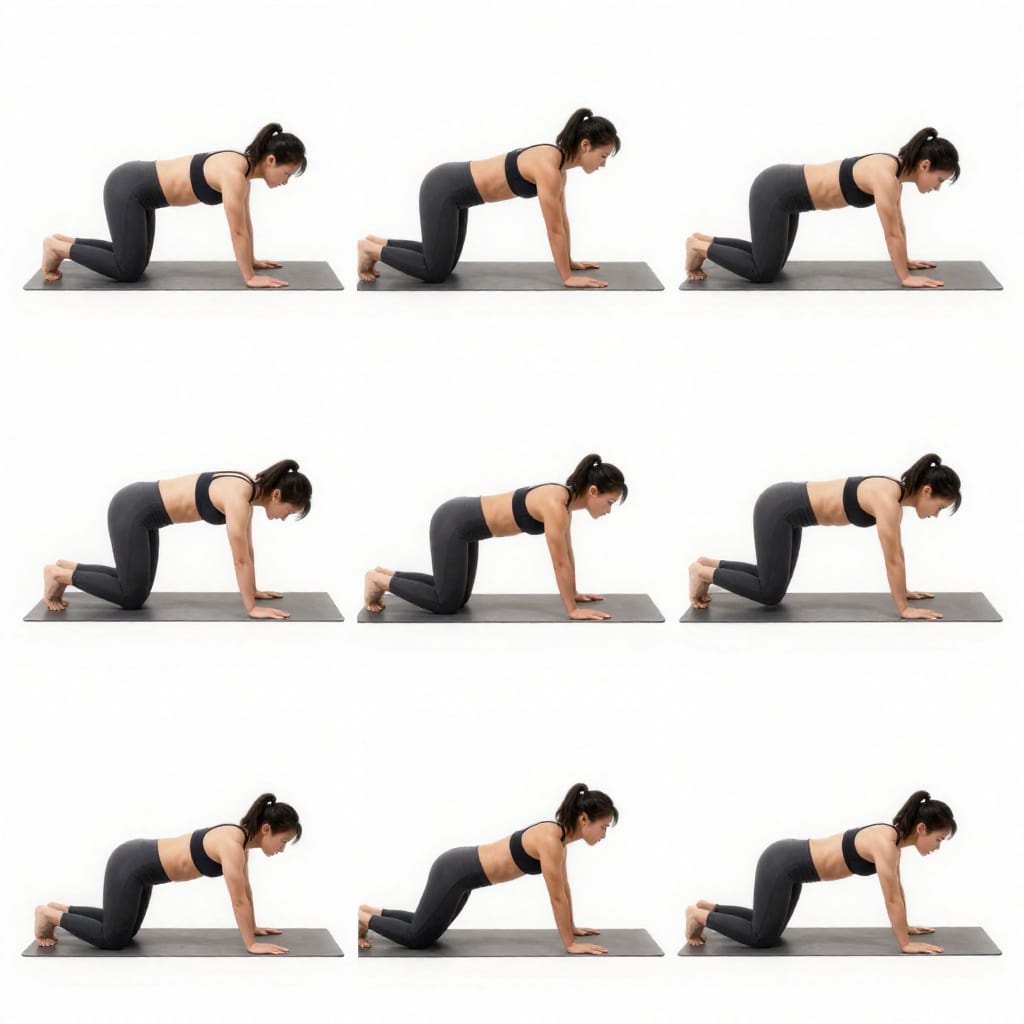
7. Mountain Climbers
Why it torches fat: Mountain climbers are a dynamic full-body move that combines a plank with alternating knee drives. They engage your core, shoulders, and hip flexors while keeping your heart rate elevated. When done at a fast pace, they rival running in terms of calorie burn—about 8–10 calories per minute for a 155-pound person.
How to do it right: Start in a high plank, hands under shoulders, body in a straight line. Drive your right knee toward your chest, then quickly switch legs, as if you’re running in place while holding a plank. Keep your hips low and don’t let your butt pike up. Breathe rhythmically.
Progress it: Easier: slow the pace and focus on form. Harder: cross your knee toward the opposite elbow (spider climbers), or do it with your feet on a low stool for a decline angle. Do 3 sets of 30–45 seconds.
How to Combine These Exercises Into a Fat-Burning Routine
Now that you have the moves, here’s how to string them together for maximum fat loss. The key is intensity and minimal rest, which creates the metabolic disturbance that drives weight loss.
Sample Full-Body Circuit (No Equipment, 20 Minutes)
- Squats (Jump Squats optional) — 45 seconds work, 15 seconds rest
- Push-Ups — 45 seconds work, 15 seconds rest
- Reverse Lunge with Knee Drive (alternate legs each rep) — 45 seconds work, 15 seconds rest
- Plank with Shoulder Taps — 45 seconds work, 15 seconds rest
- Glute Bridge (Single-Leg on each side) — 45 seconds work, 15 seconds rest
- Burpees (Modified if needed) — 45 seconds work, 15 seconds rest
- Mountain Climbers — 45 seconds work, 15 seconds rest
Complete all 7 exercises in order, rest 60 seconds, then repeat the circuit 2 more times (3 total rounds). Total time: about 20–22 minutes.
Progression Strategy: For the first two weeks, focus on form. If you can’t maintain good form for the full 45 seconds, reduce the work interval to 30 seconds. After two weeks, try to increase your rep count within the same time, or reduce rest to 10 seconds. Once you can complete all three rounds without breaking form, add a fourth round or extend work intervals to 50 seconds.
Frequency: Aim for 4 sessions per week, with at least one rest day in between. On rest days, do light walking or stretching—don’t underestimate the power of recovery for fat loss.
Common Mistakes That Kill Your Weight Loss Results (and How to Fix Them)
Over the past two years, I’ve made every mistake in the book. Here are the three that wasted the most time, and how to avoid them.
Mistake #1: Treating bodyweight workouts like a casual stretch. The biggest error I see is people going through the motions without intention. If you can hold a conversation easily during your workout, you’re not working hard enough. Bodyweight training for weight loss needs to feel challenging—you should be breathing hard by the end of each work interval, and your muscles should feel fatigued. Fix it: use a timer and push yourself to get one more rep or hold that plank for five more seconds.
Mistake #2: Ignoring progressive overload. Your body adapts quickly. If you do the same number of squats every workout for a month, your calorie burn will plateau. I learned this the hard way—after three weeks of great progress, I stalled for two weeks because I never increased my intensity. Fix it: add one more rep per set each week, or reduce rest by 5 seconds, or switch to a harder variation (e.g., jump squats instead of standard squats).
Mistake #3: Skimping on nutrition. You can’t out-train a bad diet. I once did 45-minute bodyweight circuits six days a week and didn’t lose a pound because I was eating back all the calories in snacks. Bodyweight exercises create a calorie deficit only if your total energy intake is lower than your expenditure. Fix it: track your food for a week using an app like MyFitnessPal, just to see where you’re at. Aim for a deficit of 300–500 calories per day, combined with your workouts.

Frequently Asked Questions About Bodyweight Workouts for Weight Loss
Can you really lose weight with just bodyweight exercises at home?
Yes—when combined with a calorie deficit and progressive overload, bodyweight exercises burn significant calories and build metabolism-boosting muscle. I lost 8 pounds in my first six weeks, and I wasn’t even being strict with my diet. The key is consistency and intensity.
How many times a week should I do bodyweight workouts for weight loss?
Aim for 3–5 sessions per week, mixing full-body circuits with active recovery (like walking or yoga) to avoid overtraining while maximizing fat burn. More than five sessions can lead to burnout or injury, especially if you’re pushing hard.
Do I need to do long sessions for results?
No. In fact, 20–30 minute high-intensity circuits can be more effective for weight loss than longer, lower-intensity sessions. The afterburn effect from HIIT-style bodyweight training keeps your metabolism elevated for hours after you finish.
What if an exercise is too hard or too easy?
Modify using easier variations (e.g., knee push-ups, step-back burpees) or harder progressions (e.g., jump squats, decline push-ups) to match your fitness level. The goal is to work at an intensity that feels like a 7–8 out of 10 on effort scale—challenging but sustainable.
How soon will I see weight loss results from bodyweight training?
With consistency and proper nutrition, most people notice changes in energy and body composition within 2–4 weeks. Scale weight may fluctuate, so pay attention to how your clothes fit and how you feel. I saw visible changes in my arms and legs around week three.
Your Takeaway: Start Tonight, No Excuses
You don’t need a gym, a personal trainer, or a single piece of equipment to start losing weight. The seven exercises I’ve shared are the same ones I’ve used to drop weight, build strength, and actually enjoy my workouts again. My advice: pick three of these moves tonight, do each for 45 seconds with 15-second rest, repeat for 15 minutes, and see how you feel tomorrow. That’s it. No planning, no gear, no waiting. The only thing standing between you and your goal is the decision to start.
Worth bookmarking before your next home workout session—you’ll thank me later.